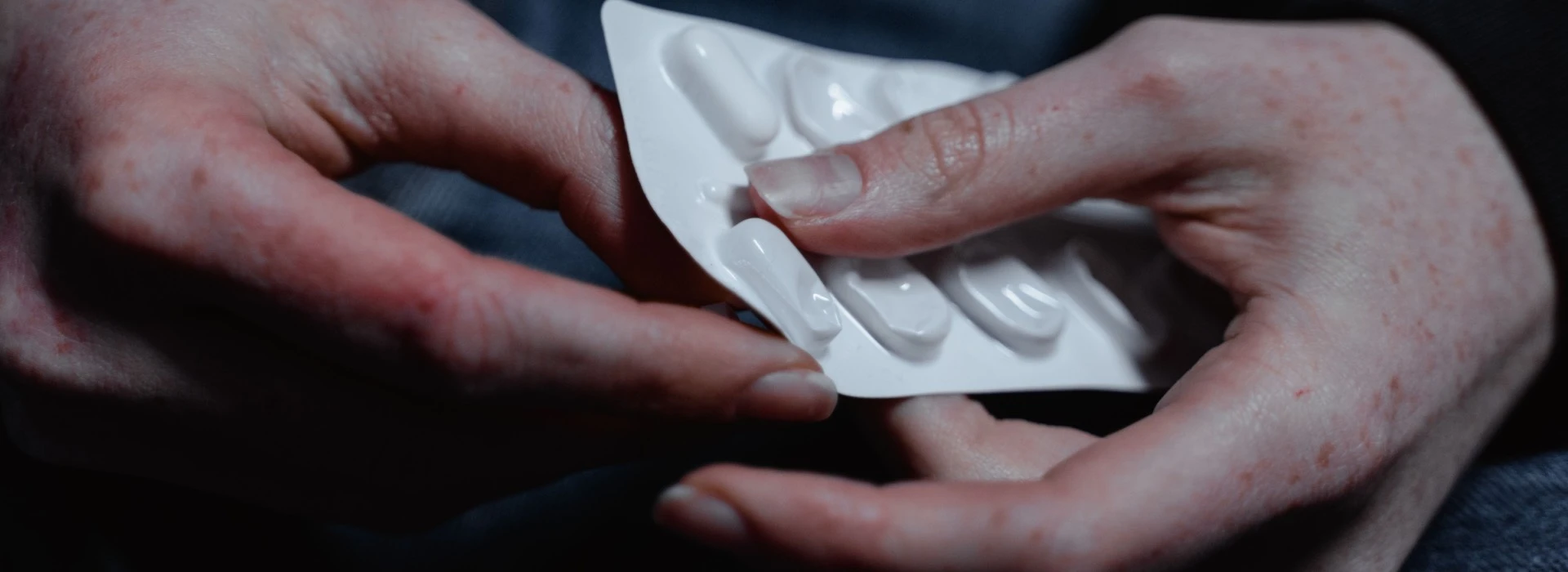
Percocet is a United States brand name for a tablet containing two medicines. One is oxycodone, an opioid. The other is the painkiller sold in America as acetaminophen and everywhere else as paracetamol. Almost everything written about Percocet addiction treats it as an opioid story. Half of it is not.
A note on language. We write in British English for readers who are mostly American, so our prose says paracetamol while US regulators are quoted exactly as published.
The brand is American, and there is no exact British version
The US Drug Enforcement Administration’s evaluation of oxycodone describes the drug as marketed “as a single entity” and “in combination with other nonnarcotic analgesics such as aspirin (Percodan), or acetaminophen (Percocet, Oxycet)”. It is “a schedule II controlled substance under the Controlled Substances Act”.
The UK picture differs. The electronic Medicines Compendium, the register of licensed UK product information, returns no results for Percocet and none for oxycodone with paracetamol, while a search for oxycodone alone returns dozens of products whose only listed active ingredients are oxycodone hydrochloride and naloxone hydrochloride. That is a verified absence rather than a claim about all of British medicine, but our reading is that the UK does not license this combination.
Britain has oxycodone alone, which the NHS calls “a medicine used to treat severe pain” and “a type of medicine called an opioid”, sold as OxyContin, OxyNorm, Longtec and Shortec. Where a UK product does pair paracetamol with an opioid it is usually codeine or dihydrocodeine, as in co-codamol, and we have written separately about codeine with alcohol, where the paracetamol material overlaps this page.
On the law, quoted rather than asserted: the UK Government’s list of drugs controlled under the Misuse of Drugs legislation records oxycodone as Class A, Schedule 2. That is a legal question, not a clinical one.
The two halves of the tablet fail in different ways
The opioid half behaves like one. The DEA states that “the pharmacology of oxycodone is essentially similar to that of morphine, including its abuse and dependence liabilities”. The boxed warning on the US label says “serious, life-threatening, or fatal respiratory depression may occur”, and that adding alcohol or other “central nervous system (CNS) depressants” may cause “profound sedation, respiratory depression, coma, and death”.
The paracetamol half fails elsewhere. The same boxed warning states that “acetaminophen has been associated with cases of acute liver failure, at times resulting in liver transplant and death”. It attributes most liver injury to intake above a daily maximum this page does not print, and to taking more than one paracetamol-containing product. The label adds that “the risk of acute liver failure is higher in individuals with underlying liver disease and in individuals who ingest alcohol while taking acetaminophen”, and that excessive intake may be unintentional in people who “unknowingly take other acetaminophen-containing products”. LiverTox, the US National Institutes of Health reference on drug-induced liver injury, gives the scale: “Currently, acetaminophen is the major cause of acute liver failure in the United States, Europe and Australia.”
The DEA connects the halves, warning that products combining oxycodone with acetaminophen “pose an additional risk of liver toxicity” with sustained use. Our extension, rather than any source’s finding: that is the structural difference between a combination tablet and the opioid alone. Tolerance to an opioid rises, but it brings no cross-tolerance to paracetamol’s toxicity in the liver, so a body adapted to one half has no protection on the other.
Tolerance, dependence and addiction are three different things
The US label defines the first two. “Tolerance is a physiological state characterized by a reduced response to a drug after repeated administration.” “Physical dependence is a state that develops as a result of a physiological adaptation in response to repeated drug use, manifested by withdrawal signs and symptoms after abrupt discontinuation or a significant dose reduction of a drug.” Both “can develop during use of opioid therapy”.
Neither is addiction, and the label sentence on that is worth reading twice: “Although the risk of addiction in any individual is unknown, it can occur in patients appropriately prescribed oxycodone and acetaminophen tablets. Addiction can occur at recommended doses and if the drug is misused or abused.” Nothing has to have gone wrong.
How often it does is narrower than the fear and wider than the reassurance. The label reports a prospective cohort study of people starting long-term use of Schedule II opioid painkillers between 2017 and 2021. Over twelve months, “approximately 1% to 6% of participants across the two cohorts newly met criteria for addiction”, assessed against DSM-5 criteria for moderate-to-severe opioid use disorder, while “approximately 9% and 22% of participants across the two cohorts newly met criteria for prescription opioid abuse and misuse”. We publish the label’s own caveat with its numbers: the estimates “may not be generalizable to all patients receiving opioid analgesics”, and they cover Schedule II opioids as a class rather than this brand.
Withdrawal is miserable, and that is not the same as dangerous
The World Health Organization’s withdrawal guidelines put it plainly. Opioid withdrawal “can be very uncomfortable and difficult for the patient”, it “can feel like a very bad flu”, and “however, opioid withdrawal is not usually life-threatening”. The listed symptoms are nausea and vomiting, anxiety, insomnia, hot and cold flushes, perspiration, muscle cramps, watery discharge from eyes and nose, and diarrhoea.
Set that beside the same document on other drugs: Of alcohol: “in rare cases, alcohol withdrawal can be life-threatening and require emergency medical intervention.” Of benzodiazepines, that gradual reduction helps “prevent the development of seizures”. The contrast matters if someone is drinking heavily alongside a prescription, because the alcohol is then the part that makes stopping unsupervised dangerous. The guidelines were written for closed settings such as prisons, which limits how far they read across.
Two inconvenient halves. The misery does not end when the acute phase does: WHO describes a protracted phase “that lasts for up to six months and is characterised by a general feeling of reduced well-being and strong cravings for opioids”. And everyone who has withdrawn “should be advised that they are at increased risk of overdose due to reduced opioid tolerance”. The withdrawal is not usually the dangerous part. What can follow it is. The label is equally direct the other way, instructing prescribers not to “rapidly reduce or abruptly discontinue” the tablet in someone physically dependent, because that “may lead to serious withdrawal symptoms, uncontrolled pain, and suicide”. If you are having thoughts of suicide, contact your local emergency services or a local crisis line now. Neither stopping nor continuing is a decision to make alone.
The road to heroin, measured rather than remembered
Everybody has heard that prescription painkillers lead to heroin. The data is less tidy.
Compton, Jones and Baldwin reviewed the evidence in the New England Journal of Medicine in 2016 and reported both directions of it. Backwards from heroin the association is strong: they cite work finding “79.5% of persons who recently began using heroin had used prescription opioids non-medically before initiating heroin use”. Forwards it collapses. “Only a small percentage of nonmedical users of prescription opioids initiate heroin use”, at 3.6 per cent initiating heroin within five years in one study, and 4.2 per cent of past-year non-medical users also reporting past-year heroin use in 2011 to 2013 in another. They conclude that such use “is neither necessary nor sufficient for the initiation of heroin use”.
The same authors immediately qualify that small percentage: “Of note, given the large number of nonmedical users, even a small percentage who initiate heroin use translates into several hundred thousand new heroin users.” A low rate across a very large exposed population is still a great many people, and both halves are true at once.
Carlson and colleagues followed 362 young people using pharmaceutical opioids illicitly, none opioid-dependent at the start. Over 36 months, 27 of them, or 7.5 per cent, initiated heroin use, at 2.8 per cent per year. That is one sample from one part of the United States, everyone who transitioned was white, and it was built to find predictors rather than represent everyone.
Then the pattern moved. Cicero and colleagues found that among people entering treatment for opioid use disorder, the share whose first regular opioid was heroin rose from 8.7 per cent of those starting in 2005 to 33.3 per cent in 2015, overtaking prescription opioids. It has shifted again since. A CDC analysis of overdose deaths across 29 states and Washington DC found the quarterly share with evidence of counterfeit pill use “more than doubled from 2.0% during July-September 2019 to 4.7% during October-December 2021, and more than tripled in western jurisdictions”, with illicitly manufactured fentanyls the only drugs involved in 41.4 per cent of those deaths.
Our synthesis, rather than any one paper’s finding: the sharpest danger now is not a decision to try heroin. It is a pill that looks like the one from the pharmacy and is not.
If you are wondering about yourself or someone else
There is no question set here that lets you conclude you are fine, because no honest one exists. Thinking about the next prescription, taking it for something other than pain, or finding that stopping feels unmanageable is worth saying to a clinician. So is simply being worried.
The emergency needs naming. Breathing that is slow, shallow, noisy or irregular, in someone who cannot be woken, is one whatever else was taken. Call your local emergency services, 911 in the United States or 999 in the UK, and do not wait to see whether they sleep it off. Naloxone reverses opioid overdose, and emergency services should still be called when it has been used.
Talking to us
The Orchid Recovery is a residential addiction and mental health treatment centre in Hang Dong District, Chiang Mai, Thailand, for international English speaking adults, Americans included. If a prescription has become something you organise your week around, our pages on opioid addiction treatment and prescription drug addiction treatment explain what a programme involves, opioid detox programmes covers the supervised part, and heroin and opioid withdrawal what that week is like. Where alcohol or a sedative is also present, polysubstance use is the more relevant read. Our clinical team is listed here, and you can speak to us if it would help.
Most people reading this will not need residential treatment, which is the right outcome. A shorter starting point is prescription drug addiction help.
Sources
- DEA Diversion Control Division, Drug and Chemical Evaluation Section, Oxycodone, September 2025
- DailyMed, Oxycodone Hydrochloride and Acetaminophen tablets, US prescribing information including boxed warning
- FDA, PERCOCET (Oxycodone and Acetaminophen Tablets, USP) CII, approved labelling
- LiverTox, Acetaminophen, NCBI Bookshelf, National Institute of Diabetes and Digestive and Kidney Diseases
- NHS, Oxycodone
- electronic Medicines Compendium, search for oxycodone
- GOV.UK, List of most commonly encountered drugs controlled under the Misuse of Drugs legislation
- World Health Organization, Clinical Guidelines for Withdrawal Management and Treatment of Drug Dependence in Closed Settings, NCBI Bookshelf
- NIDA, Prescription Opioids DrugFacts
- Compton WM, Jones CM, Baldwin GT, Relationship between Nonmedical Prescription-Opioid Use and Heroin Use, N Engl J Med 2016;374(2):154-63
- Carlson RG et al, Predictors of transition to heroin use among initially non-opioid dependent illicit pharmaceutical opioid users, Drug Alcohol Depend 2016;160:127-34
- Cicero TJ, Ellis MS, Kasper ZA, Increased use of heroin as an initiating opioid of abuse, Addict Behav 2017;74:63-66
- O’Donnell J et al, Drug Overdose Deaths with Evidence of Counterfeit Pill Use, United States, July 2019 to December 2021, MMWR Morb Mortal Wkly Rep 2023;72(35):949-956
Frequently Asked Questions
Is Percocet addictive?
Yes, and the US label is explicit that this is not confined to misuse. It states that although the risk in any individual is unknown, addiction "can occur in patients appropriately prescribed" the tablet, and "can occur at recommended doses". Oxycodone is a Schedule II controlled substance in the United States and Class A, Schedule 2 in the UK. Being prescribed it correctly does not remove the risk.
What is Percocet called in the UK?
There is no UK equivalent under that name. A search of the electronic Medicines Compendium returns no Percocet product and no licensed combination of oxycodone with paracetamol. UK oxycodone is sold on its own as OxyContin, OxyNorm, Longtec and Shortec. British combination painkillers containing paracetamol pair it with codeine or dihydrocodeine, as in co-codamol, rather than with oxycodone.
Why is the paracetamol in Percocet a problem?
Because it fails differently from the opioid. The US boxed warning states that acetaminophen has been associated with cases of acute liver failure, at times resulting in liver transplant and death, and LiverTox describes it as the major cause of acute liver failure in the United States, Europe and Australia. The label also warns that risk is higher with underlying liver disease and with alcohol.
Is Percocet withdrawal dangerous?
The World Health Organization describes opioid withdrawal as very uncomfortable, like a very bad flu, and states that it "is not usually life-threatening", unlike alcohol withdrawal which it says can be. That is not a reason to do it alone. WHO warns that anyone who has withdrawn faces increased overdose risk from reduced tolerance, and the label warns against abrupt discontinuation in someone physically dependent.
How long does Percocet withdrawal last?
No web page can give you your own timeline, and we do not publish one. What WHO does describe is that the acute phase is followed by a protracted phase lasting up to six months, characterised by a general feeling of reduced well-being and strong cravings. That second phase is the part most people are not warned about, and it is one reason unsupported withdrawal so often does not hold.
Does taking Percocet lead to heroin?
Usually not, though the association exists. Reviewing the evidence in 2016, Compton and colleagues reported that only a small percentage of people using prescription opioids non-medically go on to heroin, citing figures of roughly 3.6 and 4.2 per cent, and concluded such use is "neither necessary nor sufficient" for heroin initiation. The stronger present risk is counterfeit pills containing illicitly made fentanyl.
What is the difference between Percocet and oxycodone?
Oxycodone is the opioid. Percocet is a US brand of tablet containing oxycodone plus paracetamol. Everything true of oxycodone is true of Percocet, with a second and separate liver risk added by the paracetamol. The DEA describes oxycodone's pharmacology as essentially similar to morphine, and warns that the acetaminophen combinations carry an additional risk of liver toxicity.
I take it as prescribed but I think about it constantly. Is that addiction?
It is worth a conversation and it is not something to settle from a web page. Tolerance and physical dependence are normal physiological adaptations and are not the same as addiction. Preoccupation, taking it for something other than pain, or dreading running out are worth describing to your prescriber honestly. If everything is fine, you have lost nothing by asking.
What does a residential programme for opioid dependence actually involve?
An assessment first, then supervised withdrawal where a doctor judges it necessary, then the part that decides whether it holds: individual and group therapy, trauma work where trauma is driving it, and planning for the reduced tolerance that follows withdrawal. Programmes run four, eight or twelve weeks, with two months of aftercare included. Email <a href="mailto:admissions@orchidrecoverythailand.com" target="_blank">admissions@orchidrecoverythailand.com</a> to ask what would suit.